

.png)
This Free AI Tool Can Turn a Photo Into a Talking Video

Introduction
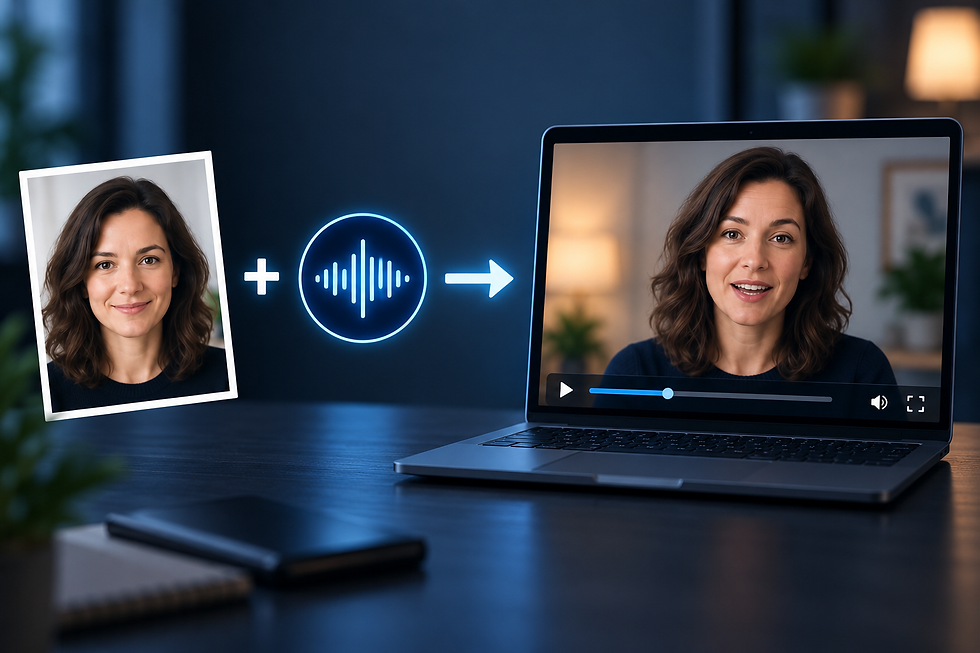
Imagine someone has a photo of you. They also have a recording of your voice—maybe from a video you posted online, a voicemail, a podcast, or even a virtual meeting.
Until recently, turning those two things into a convincing video of “you” speaking required specialized tools and quite a bit of work from an expert.
Now, almost anyone can make fake videos that really look and sound like you. In fact, one company recently released a comprehensive video software that mimics a real talking head, down to synchronized voicing.
The technology itself has plenty of legitimate uses. It also gives us another reason to reconsider an increasingly outdated assumption: Seeing someone on video does not necessarily mean they actually recorded it.
What Is LongCat-Video-Avatar?
Chinese technology company Meituan has released an open-source AI platform called LongCat-Video-Avatar 1.5. It can use images and audio to create realistic talking-avatar videos with synchronized lip movement, facial expressions, and body movements. The video-generation model takes your reference material, such as an image and audio clip, and then generates a video in which the subject appears to speak along with the supplied audio.
The latest version goes well beyond simply moving a mouth. It improves lip synchronization, facial expressions, body movement, and consistency during longer videos. It can also handle multiple people, and even generate talking versions of animated characters and animals.
The latest version also reduced the model’s generation process to just eight inference steps, making it about 15 times more efficient than its previous approach.
That technology is pretty impressive. It’s also scary to think about just how accessible this type of video manipulation has become, and what risks we face when threat actors get a hold of it.
What Are Open-Source Models?
LongCat-Video-Avatar isn't just a feature hidden inside an expensive video-production platform. The developers released the model and code publicly. That means developers can download it, experiment with it, modify it, and build other applications around it.
This is known as an open-source model. There are plenty of good reasons to use one.
Someone can create training videos without repeatedly filming a presenter. That means businesses can produce multilingual content easily, educators can even make virtual instructors, and creators can animate characters without traditional video production tools.
Unfortunately, useful technology rarely stays useful only to people with good intentions. The same basic capability can help someone create a video that appears to show a real person saying something they never said. That’s known as deepfaking, and you can see how quickly that leads to trouble.
Your Photos and Videos Are More Valuable Than They Look
This is where the technology becomes relevant to practically everybody.
Think about how much material we publish online, even when we don’t think it matters. For instance, your social media profile may contain dozens of clear photos of your face. LinkedIn may have a professional headshot, while Instagram and Facebook could contain videos of you speaking. Your employer might even have videos of you up on its website or YouTube page.
Individually, none of those things seem particularly sensitive. However, AI changes their potential value. Photos, videos, and audio can become raw material for synthetic media.
That does not mean you should remove every photo of yourself from the internet. It just means we need to understand that publicly available media can now be reused in ways that were much harder to achieve just a few years ago.
Video Is No Longer Automatic Proof
For years, one of the easiest ways to verify someone’s identity was to simply see or hear them.
Suspicious email from your boss? Call them.
Strange message from a family member? Ask to video chat.
Although these methods still help check someone’s identity, AI now forces us to add another layer of verification.
If someone appears on video asking you to transfer money, provide a password, share a verification code, or reveal sensitive information, then the video itself should not override everything else you know about security.
Pay attention to the request, not just the face making it. Question:
Does this person normally ask you for money this way?
Are they asking you to ignore a normal procedure?
Are they creating unusual urgency?
Can you verify the request through another method?
Those questions matter, even when the person looks and sounds completely real.
Not Every Video Presents Danger
AI-generated video is not automatically dangerous. For example, tools like LongCat-Video-Avatar could make video production dramatically easier and cheaper for legitimate creators.
Unfortunately for our data, our habits have not caught up with technological advances.
We are accustomed to treating photos, voices, and videos as evidence. Increasingly, however, this “proof” has become yet another type of digital content for threat actors to generate and manipulate. Therefore. we need to become slightly more skeptical about what we see on our screens.
If a video is funny, entertaining, or obviously artificial, then just enjoy it.
If someone in a video suddenly asks you to send money, reveal private information, approve a login, or do something unusual, verify the request somewhere else before you act.
AI video is getting remarkably good. Therefore, our ability to question what we see needs to get better, too.


Comments